
5 AI-Era Revenue Tactics for B2B Owners
Most B2B companies I talk to are sitting on 20-40% of revenue capacity they cannot access. Not because their product is weak or their market is small. Because their sales operation leaks at the seams.
I work with owners who bought AI tools expecting efficiency and got chaos instead. Polluted CRMs. Confused reps. Deals that should close going dark.
The good news: five specific tactics consistently turn that around. These are not theoretical. They come from implementations with B2B teams across manufacturing, professional services, SaaS, and industrial services. Every tactic includes a concrete step you can take this week.
Deploy AI Admin Assistants for Every Rep
Your reps spend the greater part of their week on non-selling tasks. That is not a productivity problem. It is a design problem. AI admin assistants handle CRM updates, meeting notes, follow-up scheduling, and data entry without requiring rep intervention.
Here is how we implement this:
- Connect AI tools directly to your existing CRM (Salesforce, HubSpot, or Pipedrive)
- Auto-log calls, emails, and meetings without reps touching data entry
- Generate follow-up drafts (** keyword: DRAFTS) based on conversation context
- Update opportunity stages based on activity signals reps already generate
Typical Outcomes
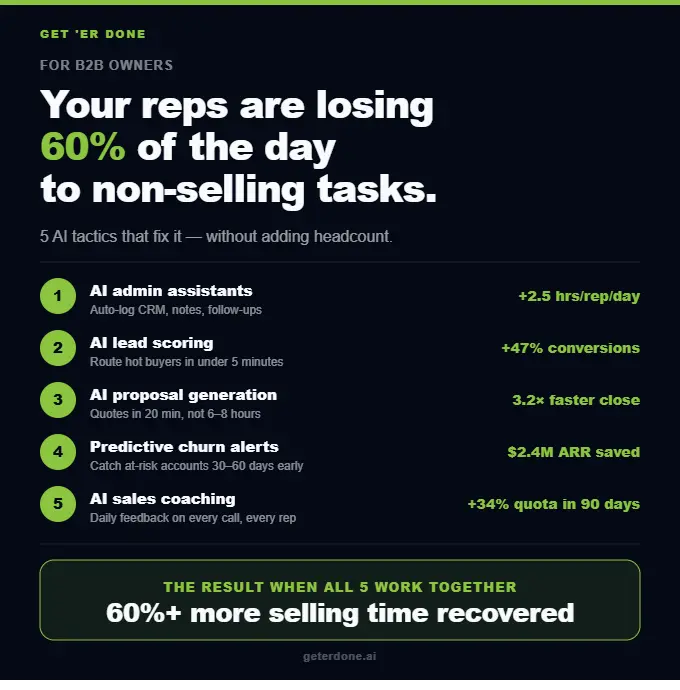
2.5 hours of selling time recovered per rep daily. For a 10-person team, that is 25 hours daily of additional revenue-generating capacity.
Explore the Reduce Admin Work solution for the full implementation framework.
Automate Lead Qualification with AI Scoring
Manual lead qualification burns 40% of rep time on prospects who will never buy. AI scoring analyzes 50+ data points instantly to prioritize high-intent buyers before they ever reach your team.
The setup looks like this:
- Integrate website behavior tracking with your CRM so intent signals flow automatically
- Configure AI models to score leads on engagement patterns, firmographics, and buying intent
- Auto-route hot leads to reps within 5 minutes of trigger actions (pricing page visits, content downloads, repeat visits)
- Filter out low-fit prospects before they consume rep attention
Typical Outcomes
Increase in conversion rates when AI-qualified leads get prioritized. Reps focus on prospects more likely to close. See your sales cycle compress after implementation.
This connects directly to our CRM Automation solution which handles the technical integration.
Deploy AI-Powered Proposal Generation
Reps spend 6-8 hours weekly building quotes and proposals. Most of that time is copy-paste formatting, not strategy. AI reduces this while improving accuracy and customization.
Implementation steps:
- Connect AI to your product catalog and pricing database with real-time sync
- Auto-generate proposals pulling from opportunity data and customer history
- Include dynamic pricing optimization based on your win/loss patterns
- Track proposal engagement with real-time buyer interaction alerts
Typical Outcomes
Faster quote-to-close velocity. AI-generated proposals include optimal pricing configurations that increase deal size by 12% on average. See your proposal win rate jump.
This tactic is part of our broader Selling Time Recovery framework.
Implement Predictive Churn Alerts
Acquiring new customers costs 5-7x more than keeping existing ones. AI identifies at-risk accounts 30-60 days before churn signals become visible to human observation.
How we build this:
- Connect customer health data: usage patterns, support tickets, payment history, engagement metrics
- Train models on historical churn patterns specific to your business context
- Alert account managers when risk scores exceed thresholds you define
- Auto-suggest retention plays based on root cause analysis of past churn
Typical Outcomes
Annual recurring revenue retained from using predictive alerts to trigger proactive retention. Early intervention consistently outperforms rescue attempts after the decision to leave is made.
For teams struggling with retention, our 1-on-1 Rep Coaching includes account management discipline alongside new business skills.
Launch AI Sales Coaching at Scale
Traditional coaching reaches each rep 2-4 times monthly. AI coaching analyzes every call, email, and meeting to deliver daily improvement feedback. The rep still owns judgment. The AI handles pattern recognition.
Implementation approach:
- Record and transcribe all sales conversations automatically with rep consent
- AI analyzes talk patterns, question quality, objection handling, and close techniques
- Deliver personalized coaching tips to reps within 1 hour of calls
- Identify skill gaps across the team for targeted group training
Typical Outcomes
Improvement in quota attainment within 90 days of AI coaching implementation. Reps receive more coaching touchpoints than traditional methods allow. The key is maintaining human verification before any AI feedback reaches performance reviews.
Our coaching program combines AI-supported analysis with human judgment to build sustainable skill improvement.
How These Tactics Work Together
The five tactics above are not isolated projects. They form a system where AI handles preparation and pattern recognition while humans own judgment and relationship.
When admin assistants free up 2.5 hours daily, reps have time to engage AI-qualified leads properly. When proposal generation takes 20 minutes instead of 6 hours, reps can pursue more opportunities. When churn alerts trigger early intervention, customer success and sales align around retention. When AI coaching delivers daily feedback, reps improve faster than quarterly review cycles allow.
Common Implementation Mistakes to Avoid
Mistake 1: Automating Without Verification
- AI drafts every email, but no human reviews before sending
- Result: Generic outreach that damages credibility
- Fix: Install mandatory human checkpoints before any AI output reaches buyers
Mistake 2: Adding Tools Without Subtracting Tasks
- New AI layer sits on top of existing workflow instead of replacing steps
- Result: Reps have more tools but same time pressure
- Fix: Map current tasks explicitly. Eliminate before you automate.
Mistake 3: Measuring Activity Instead of Outcome
- Dashboard shows 500 AI-generated emails sent. Pipeline is stagnant.
- Result: Motion masquerading as progress
- Fix: Track revenue per rep, win rate, and cycle time. Not email volume.
Where to Start This Week
If you are considering these tactics, here is a practical sequence:
Week 1: Audit where your reps' time actually goes. Categorize every task as "high-judgment" (keep human) or "high-volume/low-judgment" (automate with AI verification).
Week 2: Pick one tactic from the five above. The one that addresses your biggest time drain. Implement it fully before adding complexity.
Week 3-4: Measure reclaimed hours and early revenue signals. Adjust based on what actually changes, not what should change theoretically.
Month 2: Add a second tactic only if the first is stable and producing measurable results.
If you want help mapping which tactic fits your specific situation, our Revenue Leak Audit identifies exactly where your operation is bleeding capacity and which of these five tactics will deliver the highest ROI for your context. It is a 10-day diagnostic with a written fix list. No ongoing commitment required.