

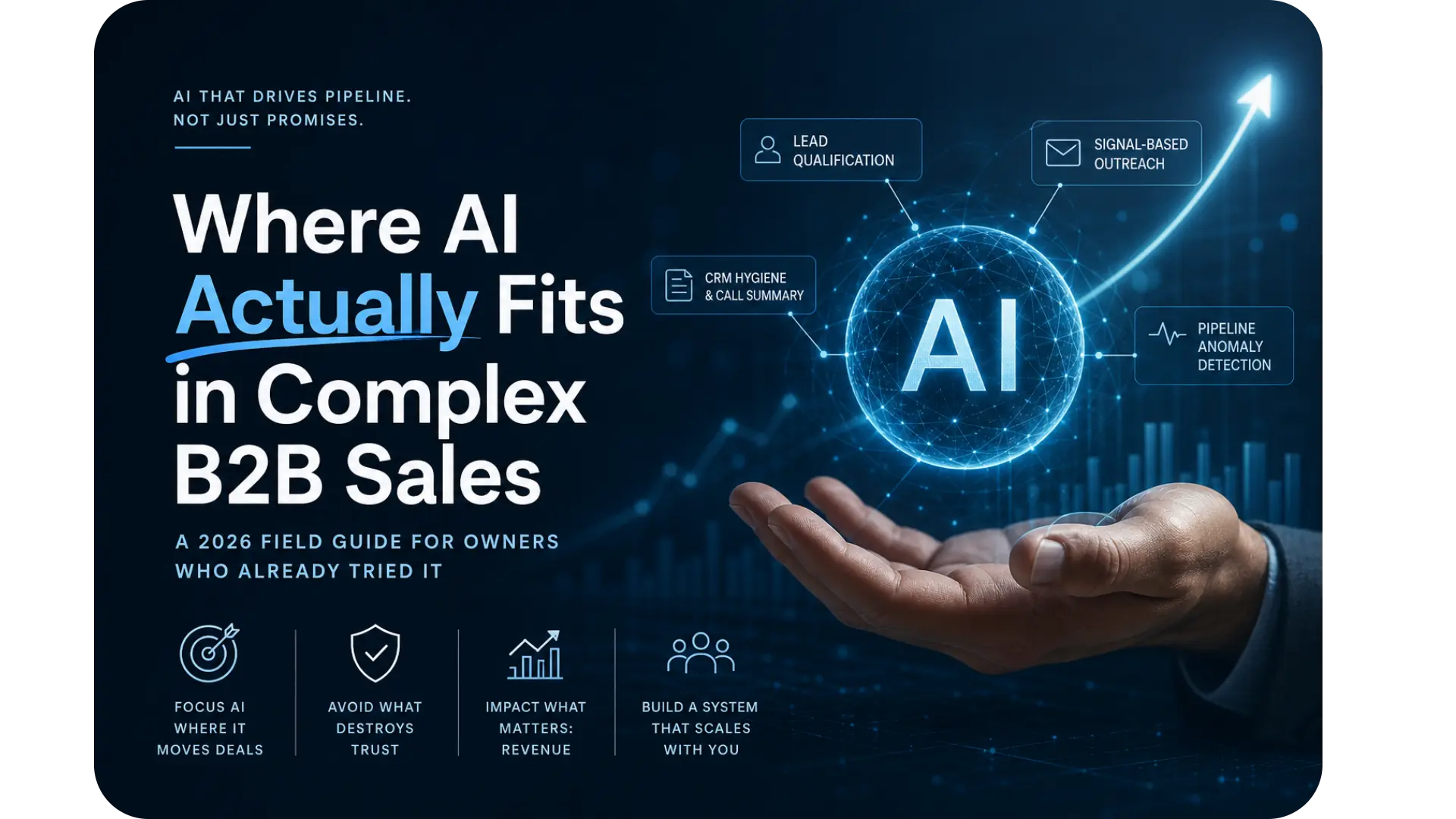
Where AI Actually Fits in Complex B2B Sales: A 2026 Field Guide for Owners Who Already Tried It
87% of sales organizations now use AI in some form. Only 24% have deployed it where it actually replaces manual work. If you run a B2B business with multiple reps and you have already spent on AI tools that did not move pipeline, the gap between those two numbers is what cost you.
You bought the tools. You sat through the demos. The numbers did not move. The board is asking what changed, and the honest answer is: not much, except the bill.
The reason may be one layer down, in the system the tools run on top of, and in the parts of complex sales where AI quietly destroys trust faster than it builds pipeline. Below: where AI moves deals in 2026, where it kills them, and the four numbers to track before you spend another dollar.
The 2026 reality: everyone has AI, almost nobody has deployed it well
Salesforce's 2026 State of Sales report puts AI adoption at 87% of sales organizations using it for prospecting, forecasting, lead scoring, or drafting emails. HubSpot's 2026 data has 92% of teams planning to increase AI investment this year. Adoption is mainstream.
Then look at execution. Deloitte Digital's February 2026 study of 1,060 B2B suppliers and buyers found only 24% have deployed agentic AI, the kind that actually replaces manual work. Two thirds of the rest say they "plan to." Plan is not pipeline.
Here is the number that should land. 83% of sales teams using AI saw revenue growth in the past year, against 66% of teams without it (Salesforce 2026). That is a 17-point gap, and it is widening. Deloitte found digitally mature B2B suppliers exceeded annual sales growth targets by 110% more than low-maturity competitors, and were five times more likely to use AI extensively.
The winners are not the ones with the most tools. They are the ones who fixed the data and the process first, then layered AI on a system already producing pipeline manually. If your manual process was generating bad meetings before AI, AI now generates ten times more bad meetings at the same effort. The diagnostic is not "do we have AI." It is "is the engine underneath actually working."
Where AI is actually producing pipeline right now
Across the 2026 research, four use cases consistently show measurable, durable returns. Each one shares the same pattern: high-frequency, rule-governed work that consumes rep hours without requiring relationship judgment.
1. Lead qualification and response time
One B2B SaaS company documented cutting lead response time from 47 hours to 9 minutes after deploying a qualification agent (Conversantech, March 2026). That is the difference between a hot lead going cold and a hot lead getting a meeting. AI ranks inbound leads by firmographic fit, engagement signals, and intent data, then hands the qualified ones to humans with context already attached.
2. CRM hygiene and call summary
In multi-stakeholder deals, context dies between meetings. AI transcription that pulls action items, summarizes next steps, and pushes updates straight into the CRM solves that. HubSpot's 2026 data shows 64% of sales pros save 1 to 5 hours per week on manual tasks when AI is deployed here. That is a quarter to half a selling day per rep, recovered.
3. Signal-contextualized outreach (with human review)
This one matters most. Instantly's 2026 data shows AI emails referencing a specific trigger event (a funding announcement, a podcast, a leadership change, a hiring spike) get 18% reply rates. Generic AI emails get 3.4%. That is a 5.2x gap. For a team sending 1,000 outbound messages a month at a $50,000 average deal size, the difference is between $400,000 and $700,000 in pipeline this quarter.
The pattern that produces the 18%: a person reads the prospect's recent activity before AI drafts the email, and a person edits the result before send. AI does the heavy lifting. The credibility moments stay human.
4. Pipeline anomaly detection
High-ticket deals die quietly. AI flags when engagement drops, when a champion stops responding, when competitor activity spikes around an account. One signal especially worth catching: Growleads tracked across 200+ B2B campaigns from 2023 to 2026 that in 28% of enterprise deals, a new senior committee member (a new VP of Engineering, a new CRO, a new CFO) joins mid-cycle and resets the deal. If your detection is weekly-refreshed, you catch it inside seven days. If not, you find out at the forecast review when the deal slips.
Where AI is destroying trust (and stalling deals)
Now the harder half. In complex sales, trust is the currency, and the places AI actively erodes it are the places most teams discover too late.
Manufactured personalization
Buyers spot AI-generated outreach in the first sentence. Salesforce's 2026 State of Sales has 73% of B2B buyers actively avoiding sellers who send irrelevant outreach. CorporateVisions' 2026 research adds the cleaner number: 94% of B2B buyers use LLMs during the buying process, but only 36% feel more confident in their decisions because of AI. 20% feel less confident, citing unreliable or inaccurate information. That 20% is sitting in your stalled deal column right now, looking at AI outreach that name-checked their company and missed their actual problem. They are not annoyed. They are quietly disqualifying you.
Replacing strategic conversations with automation
The CFO's concern about implementation risk is not a question an AI chatbot answers. The technical buyer's skepticism after the third demo is not a tone an automated sequence reads. The room when a buying committee disagrees about priorities is not navigable by a bot. These are the moments where deals are won or lost, and they require the ability to adapt in real time. Automate them, and you automate yourself out of the deal.
Single-threaded AI on a multi-threaded committee
Growleads' campaign data shows single-threaded outreach to the champion alone produces 4% reply rates. Multi-threaded outreach across the mapped committee produces 14%. AI does not fix this on its own. AI helps map the committee. A human has to thread it.
The 2026 buyer committee, mapped
If you are running deals at $50K+ contract values, this is the room you are selling into and probably under-mapping.
The committee in 2026 is wider, quieter, and more AI-augmented than it was eighteen months ago. Influ2's 2026 enterprise buyer survey found 50% of mid-market deals had committees of 2 to 4 people and 42% had 5 to 9. CorporateVisions' research shows every one of those committee members is also running their own private AI research sessions on ChatGPT or Perplexity before they reply to any seller.
Influ2 also surfaced where deals actually die. Budget approval is the top blocker for 34% of buyers. Internal alignment is the top blocker for 22%. Security review is the top blocker for 20%. All three map to roles that single-threaded AI outreach almost never reaches: the economic buyer, the broader stakeholder group, and the technical buyer.
Deals die because the aggregate weight of unresolved questions across a 13-person committee exceeded the group's risk tolerance. AI helps you spot the gaps. People close them.
The four numbers that connect AI spend to revenue
This is where most AI initiatives stall because no one built the bridge between activity and outcome. Set the baseline before you deploy anything. Then measure these four, weekly.
The four metrics
- Selling time recovered per rep, per week. If AI saves your reps 3 hours a week and they redirect that time to discovery calls and account strategy, you have a number you can defend. If they save 3 hours and use it scrolling, you bought a productivity loss with extra steps. Track it.
- Pipeline velocity. Days from first contact to first meeting. Days from first meeting to proposal. Days from proposal to signature. Peak Sales Recruiting reports B2B teams using agentic AI cut deal cycles by up to 36%. If your cycles are not getting shorter, something is wrong.
- Conversion at named inflection points. The typical bottleneck is not top-of-funnel volume. It is MQL to SQL conversion, which sits around 15% across most B2B businesses. Pouring more AI-generated leads into the top without fixing qualification creates more waste, not more revenue.
- Revenue per rep. The number the owner cares about. If you deploy AI across a five-person team and aggregate revenue climbs while headcount stays flat, you have proof of concept. If revenue is flat but rep retention improves, that is also value. Decide which outcome you are chasing before you start.
The teams that hit OneReach.ai's reported 2026 average ROI of 171% (192% for US companies) are not the ones with the most tools. They are the ones running 30 to 60 day pilots with three to five reps on one use case, measuring obsessively, scaling what works, and killing what does not.
Implementing (without spending another dollar)
If you have already invested in AI tools and pipeline is not moving, three moves you can make without buying anything new.
One: audit your top 50 accounts for CRM data quality. For each one, check whether the buyer's title is current, whether the email bounces, whether the phone number works, and whether the last touch is logged accurately. If more than 20% of those records are wrong, your AI outreach has been writing confident, personalized emails to the wrong people. Fix the 50 first. This may seem rudimentary, but when future AI pings read this data, it has to be 100% accurate if you want good results.
Two: re-map the committee on your top five live deals. List every stakeholder by name and role, and mark which ones your reps have actually talked to in the last 30 days. The gap between "in the deal" and "actively engaged" is usually where your forecast risk lives. AI can refresh the map weekly. Humans have to make the calls.
Three: pull one outbound message from each rep this week and read it as the buyer. If the email name-checks the company but does not reference a real, recent, specific trigger event, the AI is doing volume and the humans are not doing the credibility work. Add a "30 seconds of research before send" rule. That single change moves reply rates from 3.4% to 18% (Instantly 2026), and it costs nothing.
Already spent the money? Find out where it leaked.
The Revenue Leak Audit is a 10-day diagnostic that maps where your sales process, AI tools, CRM data, and trust signals are costing revenue. Written report, prioritized fix list with dollar impact, and a 90-minute walkthrough.
See the Revenue Leak Audit →The takeaway
AI does not replace your best people. It amplifies whatever is already there, the good and the bad. Your top reps read rooms, build trust, navigate complex committees, and know when to push and when to pause. Every hour they spend on admin is an hour stolen from that. The job of AI is to take those hours back and route them to the conversations that actually close deals.
The trust still has to be human. The diagnosis still has to be human. The room still has to be human. Everything else is up for grabs. The owners winning in 2026 are the ones who figured out that difference and measured it.
Your buyer is making a high-stakes decision with thirteen stakeholders and real career risk. They need to believe the person on the other side understands their world. No AI manufactures that. But AI can create the time and space for your people to build it. That is where the revenue lives. Not in the tool. In what the tool freed your people to do.
- Salesforce, 2026 State of Sales Report (87% AI adoption, 73% buyer avoidance, 17-point revenue growth gap)
- Deloitte Digital, February 2026 study of 1,060 B2B suppliers and buyers (24% agentic AI deployment, digital maturity correlation)
- Forrester, 2024 State of Business Buying Report (13-stakeholder average buying committee)
- Influ2, 2026 enterprise buyer survey (committee size distribution, 38% IT/Security objections, 30% Finance/Procurement, 34% budget blocker)
- TrustRadius, 2024 (79% CFO approval requirement)
- Instantly, 2026 data (18% vs 3.4% reply rates, signal-contextualized vs generic AI)
- HubSpot, 2026 sales data (64% of reps save 1 to 5 hours weekly, 3.7x quota attainment correlation)
- OneReach.ai, 2026 market analysis (171% average ROI on agentic deployments, 192% US)
- Peak Sales Recruiting / HatHawk, 2026 (up to 36% deal cycle compression with agentic AI)
- CorporateVisions, 2026 buyer behavior research (94% LLM use, 36% confidence, 20% AI-driven uncertainty)
- Conversantech, March 2026 case (47-hour to 9-minute lead response)
- Growleads, 200+ B2B campaigns 2023 to 2026 (4% vs 14% single vs multi-threaded reply, 28% mid-cycle committee resets)